

High temperatures can make any workshop, warehouse, or factory floor hard to work in. And once the heat builds up past 82 degrees, it becomes an OSHA issue that can put your team in danger. Since traditional A/C systems are expensive to install and regular fans rarely make a noticeable difference in large spaces, industrial evaporative coolers hit that sweet spot.
These coolers use water to naturally lower its air temperature and push it across wide areas without heavy energy use. They’re built for open environments where constant airflow can affect people and productivity.
In this guide, we’ll break down the best industrial evaporative coolers so you can choose the one that fits your building, climate, and daily workload.
Table of Contents
Best Industrial Evaporative Coolers
Let’s look at the best industrial evaporative coolers so you can keep your team fresh where they need it most.
- Cool Boss CB-28HV Desert Storm Evaporative Air Cooler

Cool Boss’s heavy-duty flagship cooler, the CB-28HV Desert Storm, can handle the toughest industrial conditions. It uses a high-velocity 28-inch axial fan and a directional venturi cone to move an enormous amount of air with industry-leading precision and force. A direct-drive, high-torque motor and a variable frequency drive keep airflow strong while reducing energy use and long-term maintenance. It also offers integrated LED floodlighting and Bluetooth audio in one rugged, industrial-grade machine.
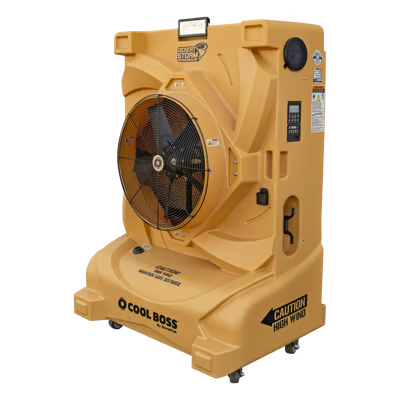
Features:
- 12,180 CFM airflow for large, demanding spaces
- 80-gallon water capacity with automatic shutoff
- Direct-drive 2.5 HP motor with VFD for controlled torque
- Touchpad controls with included remote
- 4,000-lumen LED floodlight
- Honeycool evaporative media with antibacterial housing
- 28″ axial-flow fan with 10 speed settings
- 75 dB at maximum output
- LLDPE heavy-duty housing with 4 swivel casters
- 208-240V operation (ships with cable only)
- 292 lbs empty, 958 lbs full
Pros:
- Delivers powerful airflow across wide, open areas
- Reduces maintenance needs with a direct-drive motor
- Lowers energy use through a built-in variable frequency drive (VFD)
- Adds visibility to work areas with a 4,000-lumen LED light
- Improves cooling performance with Honeycool media
- Enhances usability with touchpad controls and remote access
Cons:
- Doesn’t work in places without a 208-240V power source
Learn more about the Cool Boss CB-28HV Desert Storm.
- AIRCARE RN35W Window Evaporative Cooler

The AIRCARE RN35W is a window-mounted evaporative cooler meant for residential use that can also be used in smaller industrial spaces. It pulls fresh air through aspen fiber pads and pushes cooler air into the room without using refrigerant. The unit installs in either a vertical or horizontal window.
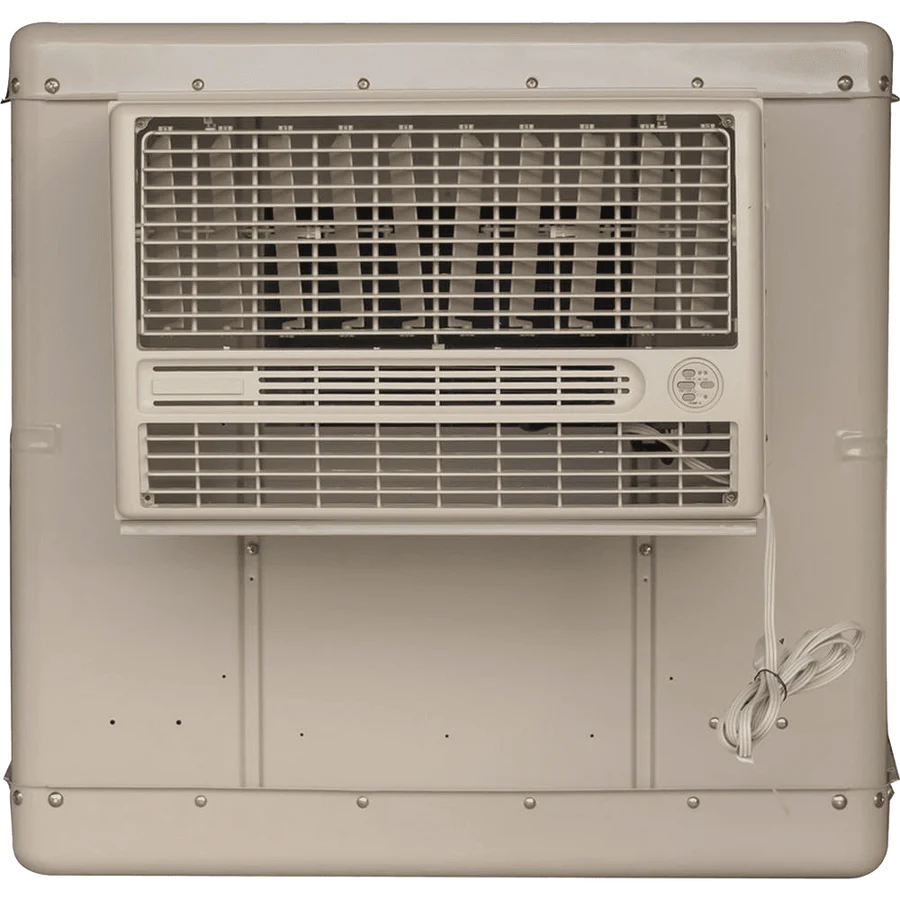
Features:
- 3,300 CFM airflow rating
- 900 sq. ft. range
- Two-speed blower with manual controls
- 110-120V operation using a standard plug
Pros:
- Installs with a simple window kit
- Filters dust and pollen
Cons:
- Works only in window-mounted applications
- Lacks portability and mobility
- Arctic ADC – 35K

The Arctic ADC – 35K, is a large, stationary cooling unit. It’s designed to supply conditioned air through long duct runs. Instead of cooling a single zone, this model connects to a building’s ductwork to distribute cooled air across multiple rooms, production lines, or open commercial areas.
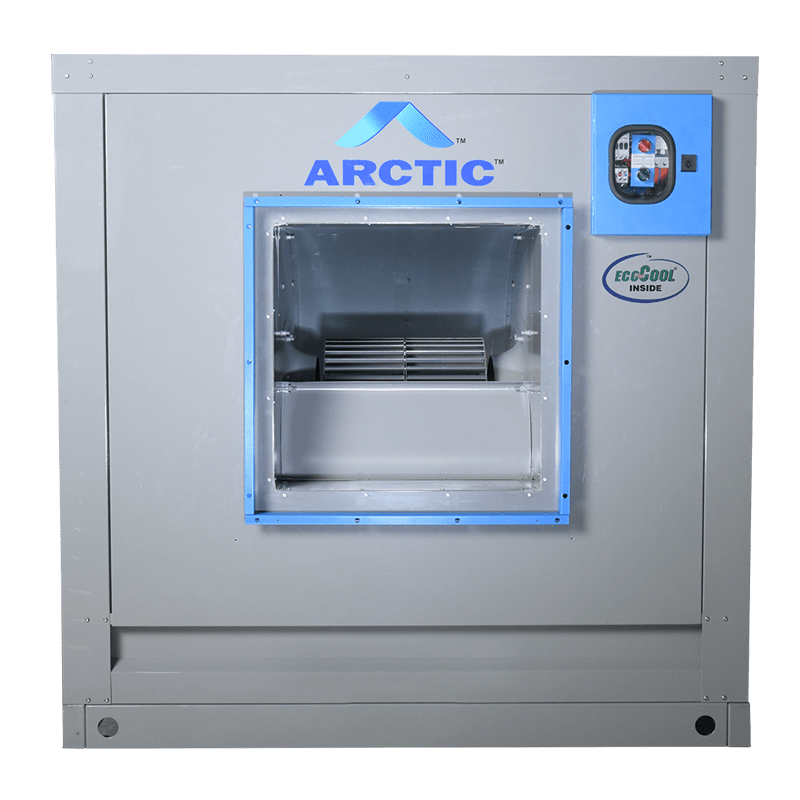
Features:
- 1450mm x 1550mm x 1450mm dimensions
- 650mm x 650mm duct connection size
- 190 tank capacity
- 295kg dry weight
- 2600m3/h air flow at given ESP
Pros:
- Supports whole-building cooling through duct networks
- Maintains airflow over long distances
Cons:
- Requires professional installation
- Lacks portability and flexibility of standalone coolers
- Big Ass Fans Cool Space 350 Evaporative Swamp Cooler
The Big Ass Fans Cool-Space 350 is a portable evaporative cooler meant for medium-sized areas. It uses resin-treated cooling media and a 20-inch fan to move a steady stream of air across workspaces. The unit can run off its internal water reservoir for up to 10 hours or connect to a standard garden hose for continuous operation.
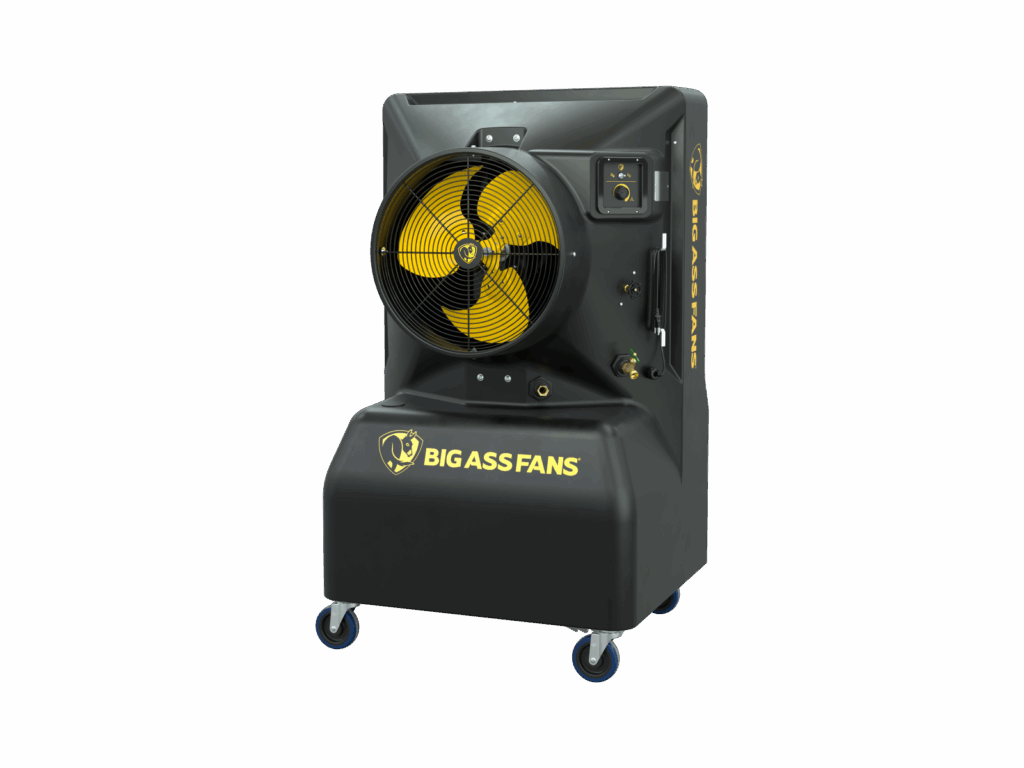
Features:
- 2,300 sq. ft. coverage
- 10-hour runtime on internal reservoir
- 20-inch fan diameter
- Variable-speed direct-drive motor
- 8-inch cooling media
Pros:
- Operates quietly
- Provides optional remote and app control
Cons:
- Offers fewer industrial-grade features compared to larger units
- Works best in dry indoor environments only
- Hessaire MC37M 3,100 CFM Evaporative Cooler
The Hessaire MC37M cooler is a smaller, portable unit. It uses three intake panels of XeL50 media to increase the amount of air passing through the pads. The axial propeller pushes air forward in a direct stream, and the unit can run from its onboard tank or a connected garden hose. Its polypropylene housing gears it toward smaller job sites, patios, or outdoor work areas.
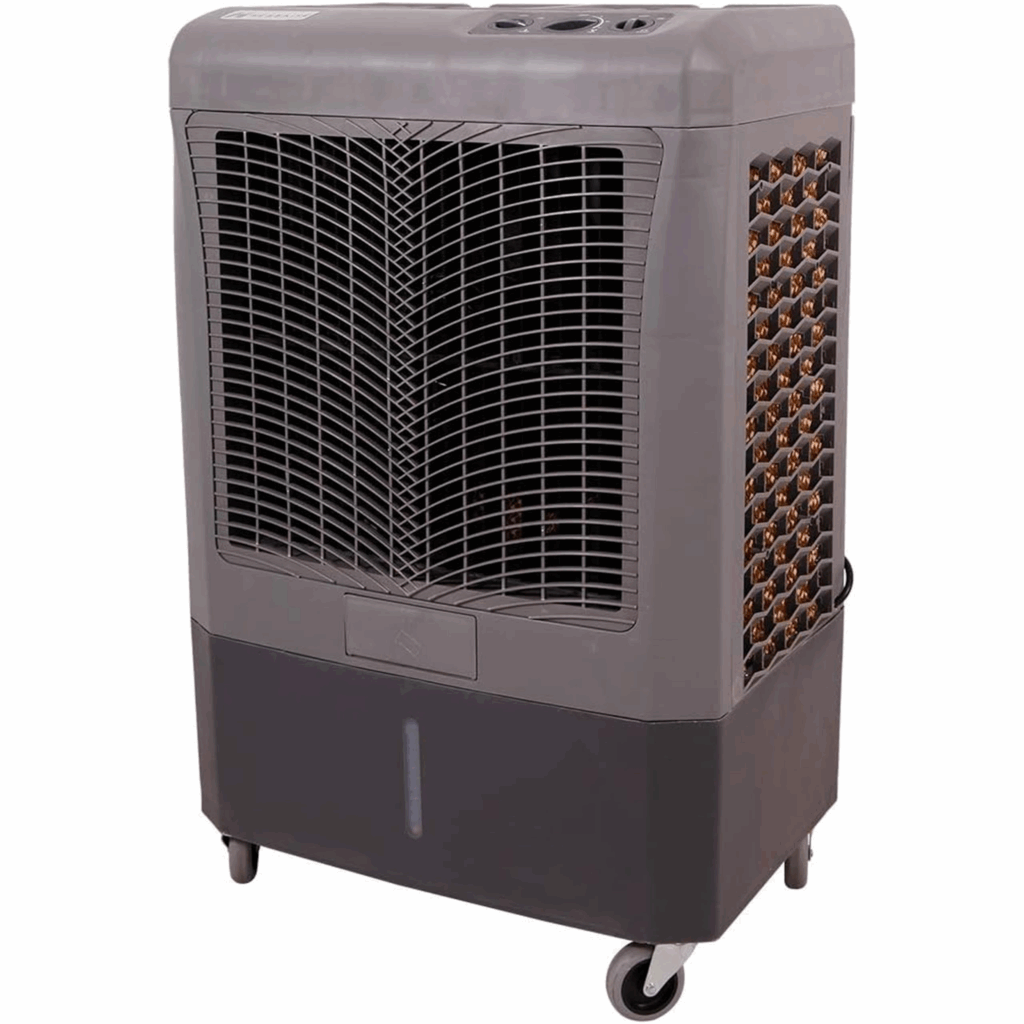
Features:
- 3,100 CFM airflow
- 950 sq. ft. coverage
- XeL50 high-density cooling media
- 10.3-gallon water tank with a 3-4 hour runtime
- Oscillating air swing delivery system
Pros:
- Fits in smaller areas
- Includes oscillation
Cons:
- Limited runtime when tank is used alone
- Not intended for enclosed indoor spaces
- Honeywell 300 CFM Portable Evaporative Cooler

The Honeywell 300 CFM portable evaporative cooler is a compact unit made for spot cooling small rooms or work areas. It uses a honeycomb cooling pad and a 300 CFM fan to produce a light, chilled breeze for spaces up to 175 square feet. The unit runs on low power, so it can be used for desks, bedrooms, or small office areas.
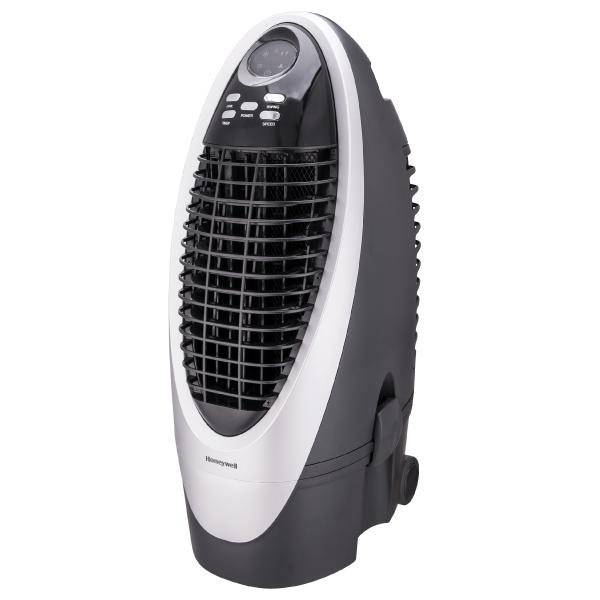
Features:
- 300 CFM airflow
- 175 sq. ft. coverage area
- 2.6-gallon 10L water tank
- Honeycomb cooling media with carbon dust filter
- 3 fan speeds
- Low water alarm
- LED control panel with timer
Pros:
- Uses less electricity than other units
- Includes remote and timer
Cons:
- Lacks power for large areas
- Requires frequent refilling due to small tank size
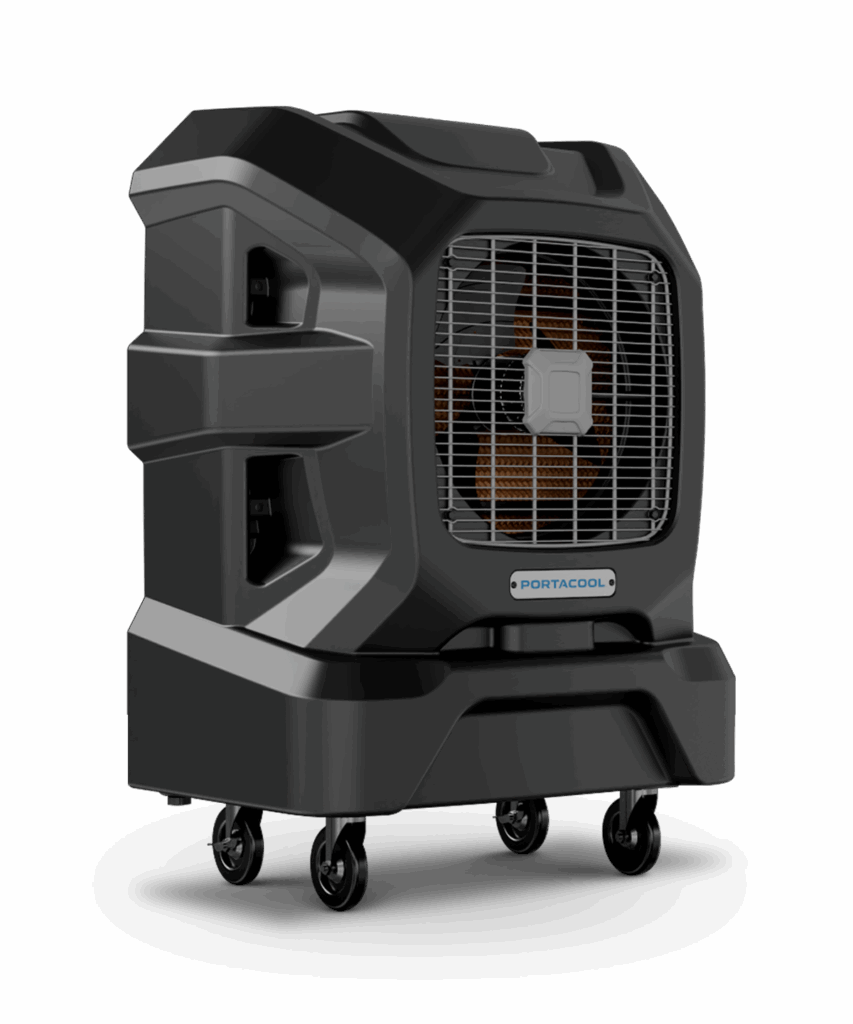
- Portacool APEX 1200

The Portacool APEX 1200 is a mid-sized evaporative cooler that delivers directional airflow across larger areas. It uses a centrifugal blower, variable speed controls, and a 40-gallon water reservoir to push air up to 40 feet while keeping noise levels low. It also allows users to adjust fan settings, check water levels, or manage multiple units from a smartphone.
Features:
- 4,000 CFM airflow
- Wi-Fi–enabled CoolSync app
- Centrifugal blower rated at 51 dB
- 40-gallon water reservoir with hatch refill or hose connection
- Digital water level indicators
Pros:
- Operates more quietly than many portable industrial coolers
- Includes digital alerts
Cons:
- Feels heavier than comparable mid-size units
- Costs more than standard evaporative coolers
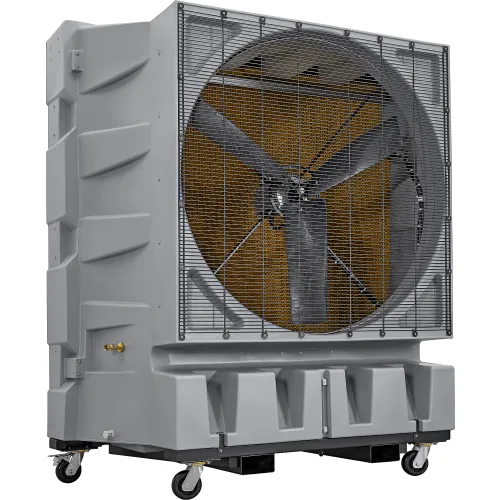
- Global Industrial™ 48″ Portable Evaporative Cooler

The Global Industrial 48″ portable evaporative cooler is geared toward large industrial spaces. It pushes up to 20,615 CFM and can cool areas over 5,000 sq. ft. The unit relies on a 92.5-gallon built-in water tank and corrugated Kraft paper media to reduce air temperatures.
Features:
- 20,615 CFM airflow rated for up to 5,382 sq. ft.
- 92.5-gallon internal water tank
- 48″ diameter fan with three selectable speeds
- LCD panel and remote control operation
Pros:
- Offers longer runtime between refills
- Includes safety shutoff
Cons:
- Weighs over 400 lbs, making it harder to move without equipment
- Comes with a higher power draw than most mid-size coolers
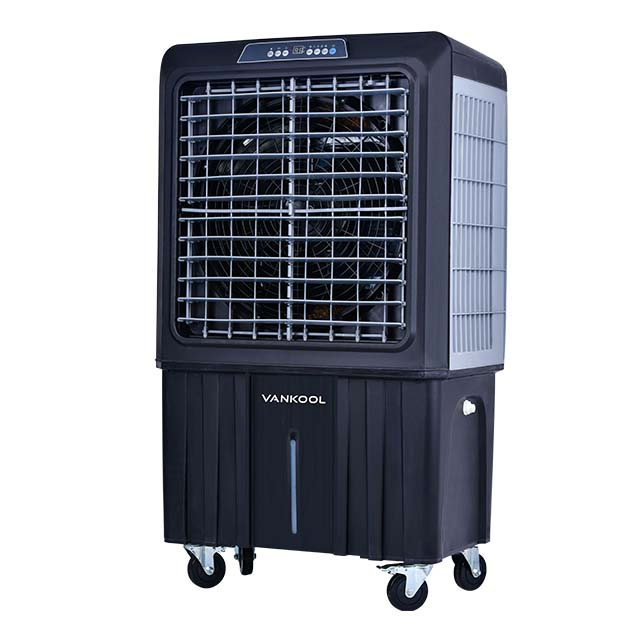
- Vankool VAB09

The Vankool VAB09 is a commercial portable evaporative cooler that uses a 4-blade axial fan and an airflow rating to push air up to 15 meters. The unit runs on a 350W motor with three speed settings and includes both onboard controls and a remote for adjustment. A 100-liter water tank supports longer runtime for users who need it.
Features:
- 9000m airflow output
- 15-meter air delivery distance
- 350W motor with 3 fan speeds
- 4-blade axial fan
- 100-liter water tank
Pros:
- Operates at relatively low noise
- Runs on low power consumption
Cons:
- Bulky and hard to move once the 100L tank is filled
- Plastic housing may not handle heavy industrial conditions as well as reinforced alternatives
How Does an Industrial Evaporative Cooler Work?
An industrial evaporative cooler uses water and air flow to lower temperatures in large, open spaces. Warm air gets pulled through water-soaked cooling pads, and as the water evaporates, it naturally drops the air temperature.
A powerful fan then pushes that cooler air across the shop floor, through open bays, or around work areas. There’s no compressor, refrigerant, or heavy installation required. You just need water and good ventilation.
Evaporative Coolers vs. Air Conditioners vs. Mist Fans
Many people group these cooling systems together, but they work very differently. Each has its own strengths depending on the space, the climate, and how much cooling you actually need. Let’s break down the differences so you know when each one makes sense:
- Evaporative coolers: Evaporative coolers use water evaporation to drop air temperature and push that cooler air through large areas. They’re great for warehouses, garages, and outdoor work sites where you need steady airflow. They use very little electricity, don’t need refrigerant, and can cool thousands of square feet for a fraction of the cost of A/C.
- Air Conditioners: These units use a compressor and refrigerant to chill air inside fully enclosed rooms. They work best in sealed spaces where doors and windows stay closed. They deliver stronger temperature drops than evaporative coolers, but they’re far more expensive to install, draw much more power, and aren’t practical for open shops or areas with constant airflow.
- Mist fans: These devices spray a fine mist into the air while a fan pushes that moisture outward. They can cool outdoor areas quickly, but they also get surfaces wet and aren’t ideal around tools, machinery, or indoor work zones. They’re better for patios, outdoor events, or other settings where a little moisture isn’t an issue.
Types of Evaporative Coolers
Each type of evaporative cooler uses water to reduce heat, but they all handle airflow and moisture differently. Let’s look at the differences to make it easier to pick the right system for your shop or workspace:
- Direct Evaporative Coolers: Direct coolers rely on a simple setup where air passes across damp cooling media and comes out noticeably cooler. They’re the most common style because they’re affordable, easy to maintain, and move a lot of air through large areas. These work best in open or semi-open spaces, where fresh air can keep circulating.
- Indirect Evaporative Coolers: Indirect coolers lower air temperature without adding moisture. They cool the air through a heat exchanger, so the air you feel stays dry while still dropping several degrees. This makes them useful in humid regions or in places where you want cooling without raising indoor humidity levels.
- Two-Stage Evaporative Cooling Systems: Two-stage systems blend both methods. The air is cooled once through a dry stage and then a second time through a wet stage. This combination creates a deeper temperature drop while keeping humidity lower than a standard direct cooler. They’re a good option for businesses that need stronger cooling but still want to avoid the cost and power draw of full air conditioning.
Factors to Consider When Choosing the Best Industrial Evaporative Cooler
Before you choose a cooler, it helps to understand what actually affects performance. Here’s what to look at before you buy.
- Climate and Humidity: Evaporative coolers perform best in dry or moderately humid areas where the air has room to absorb moisture. If your shop is in a coastal or very humid region, expect lighter cooling and make sure you have airflow from open doors or windows to keep fresh air moving in. A quick rule of thumb is the drier the air, the stronger the cooling effect.
- Cooling Capacity: Every cooler has a limit to how much space it can handle. Higher CFM ratings mean the unit can push air across wider areas like garages, warehouse bays, or open loading docks. Match the CFM to your square footage so you’re not overworking a smaller unit or wasting money on one that’s too powerful for your space.
- Water Connection: Some coolers rely on a built-in tank you refill manually, while others connect directly to a hose for continuous use. Tanks are fine for smaller shops or occasional cooling, but a hose-fed setup makes more sense if your cooler runs all day. If you don’t have a water hookup nearby, make sure the tank size fits your needs so you’re not stopping constantly to refill.
- Placement and Coverage Area: Where you set the cooler matters just as much as the size you choose. These units work best when they have open space in front of them so the airflow can travel across the shop instead of getting blocked by equipment or shelving. If your space has multiple work zones or tall machinery, you may need to position the cooler closer to the hottest areas or consider using two smaller units instead of one large one.
- Sizing: A cooler that’s too small won’t move enough air to make a difference, and one that’s too large wastes power and floor space. Start by measuring the square footage you want to cool and compare it to the manufacturer’s recommended coverage area. When in doubt, choose the size that matches your most frequently used work area so you’re cooling where people actually spend time.
Find the Best Industrial Evaporative Cooler to Meet Your Needs
Industrial evaporative coolers vary widely in capacity, coverage, and build quality, which makes choosing the right unit for your space an important call. A well-matched cooler keeps temperatures manageable, reduces heat-related slowdowns, and helps crews stay focused through long shifts.
If you want dependable airflow, durable construction, and features built specifically for industrial use, consider the Cool Boss lineup. These models range from high-output units for large facilities to portable coolers that can move wherever you need them the most.