

With more than 15 years in the automotive industry, Tyler has become a trusted voice on garage equipment worldwide. He covers everything from heavy-duty car lifts and wheel service equipment to portable car lifts, garage equipment, and shop air cooling solutions. Backed by BendPak’s legacy of innovation, Tyler helps both enthusiasts and professionals cut through the noise and choose equipment they can count on.
If you’re trying to get some cooler air into your hot shop, warehouse, or dry outdoor space, installing full A/C might not be cost-effective or practical. A full system can cost tens of thousands of dollars just to get started, not counting the monthly power bills.
That’s why many shop owners look at evaporative air coolers to bring down the temperature, provide some cool air to the area, and keep costs manageable. But with so many options on the market, how do you know which is the best?
This guide compares some popular alternatives like Portacool vs. Big Ass Fans vs. Cool Boss to find which option gives the best cooling power without crushing your budget.
Table of Contents
Why High-Performance Shop Cooling Matters
Running a shop, warehouse, or garage in the heat can be so uncomfortable that it slows your team down, makes equipment harder to use, and even drives customers away. That’s why many shop owners look for ways to cool their space without paying for a full A/C system and all the ductwork, installation, and monthly bills that come with it.
There are a few popular options on the market. Portacool is known for its portable evaporative coolers designed for industrial spaces. Big Ass Fans built their reputation on large-scale industrial fans and now offer evaporative coolers too. Cool Boss offers top quality evaporative cooling, with extras like LED lighting and Bluetooth audio for shops that want more shop-friendly features in one.
The right choice depends on your climate, space size, and how much flexibility you need. Let’s see how they compare.
Cool Boss Evaporative Cooler Review

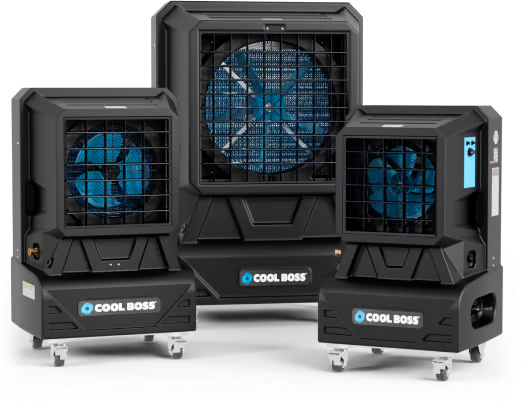
Cool Boss makes evaporative coolers for both industrial and everyday use. The COOLBLAST series brings strong cooling power to warehouses, job sites, and production spaces that need maximum airflow. The COOLBREEZE series offers portable units for mid-sized shops, dry outdoor spaces, garages, and more. Some models add features like LED floodlights and built-in audio for an elevated user experience.
Features:
- Covers spaces from 600 sq ft to over 6,000 sq ft, depending on the model
- Moves up to 12,615 CFM of airflow in the largest industrial cooler
- Drops air temperature by up to 26°F using Honeycool evaporative media
- Includes LED floodlights (4,000 lumens) on select models for nighttime work
- Offers Bluetooth audio players with stereo speakers on many units
- Runs for hours with built-in reservoirs of 15 to 115 gallons
- Features a hose connection for continuous cooling
- Offers a portable 3-in-1 Coolee series option that combines an ice chest, Bluetooth speaker, and air cooler in one
Pros:
- Covers personal outdoor cooling like tailgates, golf, and camping via the Coolee series
- Covers industrial-scale cooling like warehouses, shops, and event spaces via the evaporative cooler series
- Provides added value with lights and audio not found in most competitors
- Adds portability that makes them easy to move between work areas or outdoor spaces
- Provides efficient water use with Honeycool media and long-lasting cooling pads
Cons:
- Larger units require significant floor space in smaller shops
- Models with lights and audio are slightly higher priced than basic units
Portacool Evaporative Cooler Review

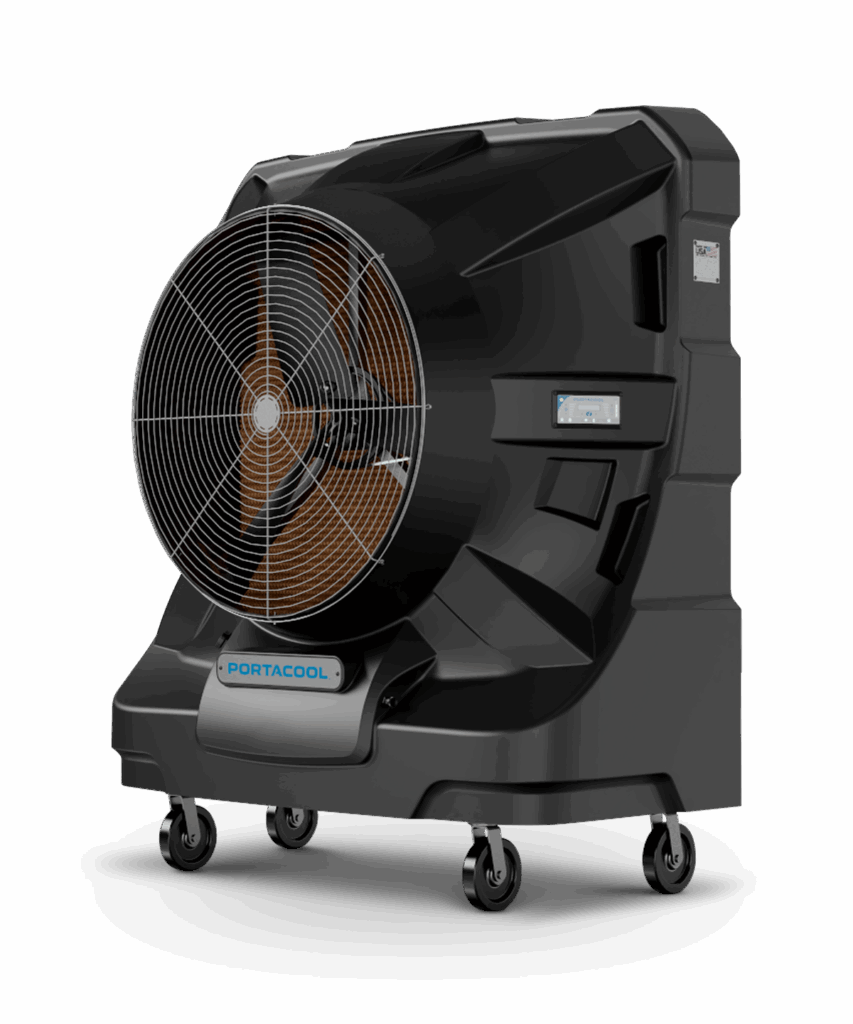
Portacool offers a line of portable evaporative coolers for shops and industrial spaces, called the APEX series. APEX models range from small units for a few hundred square feet to heavy-duty machines rated for thousands of square feet coverage.
Features:
- Covers spaces from 500 sq ft to 6,500 sq ft, depending on the model
- Offers up to 22,000 CFM
- Lets users adjust fan speed, check water levels, and schedule operation using the mobile CoolSync app
- Enhances water absorption and airflow with HydroTek media
- Operates from 53 dB in smaller units to 66 dB in larger ones
Pros:
- Gives you flexibility across different workspace sizes
- Lets you run operations via smartphone
- Operates with minimal noise
- Stretches durability
Cons:
- Adds a higher cost for larger units, since they’re engineered for industrial use and come with higher price tags
- Weighs heavier than standard coolers, meaning moving or rearranging them isn’t easy
- Lacks a hose hookup, meaning you’ll need to manage refills more often
- Requires Wi-Fi for smart control use
Big Ass Fans Evaporative Cooler Review
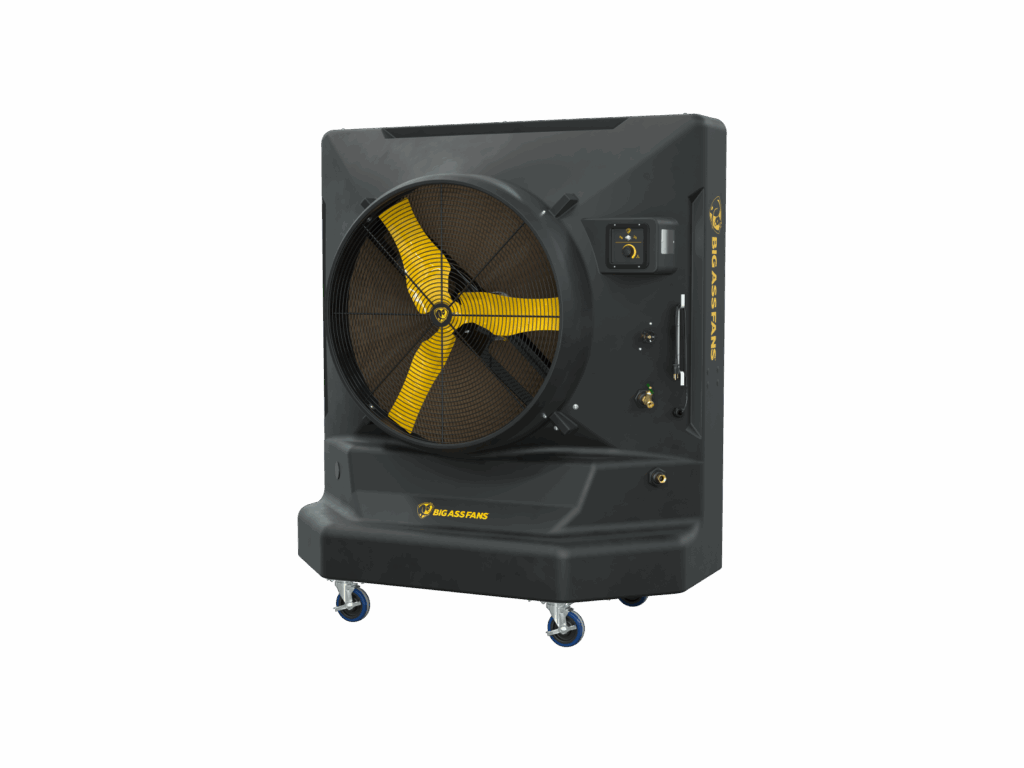
Big Ass Fans got its start offering ceiling fans for large warehouses. Now, they offer a line of evaporative coolers for medium-to-large commercial and industrial spaces. Each unit uses algae-resistant cooling pads, 16-24 gallon water reservoirs, and housings designed for heavy-duty use.
Features:
- Covers spaces from 1,200 sq ft up to 6,500 sq ft, depending on the model
- Pushes airflow up to 24,000 CFM at max capacity
- Uses chemically treated, algae-resistant cooling media
- Runs 4 to 10 hours hose-free
- Operates between 53 dB and 75 dB
- Offers Wi-Fi-enabled Kick Ass controls on higher-end models for adjusting fan speeds remotely
Pros:
- Delivers airflow for shops, warehouses, and outdoor environments
- Operates relatively quietly
- Supports hours of use
- Features durable housing components
Cons:
- Costs significantly more than many other evaporative cooler brands
- Large sizes makes them harder to fit into smaller spaces
- Needs more manual refilling for continuous use without a hose hookup
- Smart/Wi-Fi features may be unnecessary for buyers who just want straightforward cooling
How to Choose the Right Cooler or Fan
Picking the right cooler or fan is more than just grabbing the biggest one you can find. The right choice depends on your weather, the size of your space, and what you actually need the machine to do. Here are the main things to think about:
Consider Your Climate
Where you live makes a big difference. In dry, hot places like Arizona or Nevada, evaporative coolers work great because the low humidity lets them drop the air temperature fast.
In humid areas, evaporation doesn’t work as well. You might be better off with a fan that keeps the air moving, even if it doesn’t make the air itself colder.
Determine Space Size
Cooling needs change depending on the size of your space. A small garage or patio only needs a compact cooler that covers a few hundred square feet, While a warehouse or service bay needs something built for thousands of square feet. Otherwise, you’ll have hot spots the cool air never really reaches.
Compare Airflow vs Temperature Drop
Not all “cooling” is the same. Fans move a lot of air but don’t actually lower the temperature. Evaporative coolers use water to drop the air temperature, so the breeze coming out actually feels cooler. Ask yourself: Do you just want air circulation, or do you want to lower the temperature? That answer will point you in the right direction.
Evaluate Your Budget
Cost is often the deciding factor, and it’s important to look past just the sticker price. Fans might seem cheaper, but industrial models can cost thousands, and they don’t actually cool the air. A/C systems can cool big spaces, but you have to pay for ductwork, installation, and high monthly bills.
Evaporative coolers usually hit the sweet spot. They run on water and standard power, meaning no special wiring or expensive installation. You can also move them wherever you need cooling power the most, rather than being locked into one static space. Plus, they help with cost savings by using a fraction of the electricity of A/C systems.
Discover the Top Cooling Solution for Your Needs
By now, you’ve seen how different options stack up for keeping hot shops and warehouses comfortable. Each has its place, but the real question is: Which solution will keep your crew coolest day in and day out?
For those looking for the best evaporative air cooler, consider Cool Boss. These units move a ton of air, bring temperatures down, and make the space feel more comfortable to work in.
If you need cooling for large warehouses, busy job sites, outdoor events, or dry areas where A/C isn’t practical, choose one of Cool Boss’ industrial-grade units. If you need cooling on the go, try a Coolee™ portable 3-in-1 cooler. There’s always a powerful, reliable model that matches your shop size, budget, and work style.
Learn more about CoolBoss evaporative air coolers today!
Portacool vs. Big Ass Fans vs. Cool Boss FAQs
Do evaporative coolers really work?
Yes! Evaporative coolers can drop the air temperature noticeably. They work best in dry, hot climates where water evaporates quickly into the air. In humid regions, the air can’t absorb as much moisture, but it can still make a difference.
Do evaporative air coolers use a lot of electricity?
Not at all. Low electricity use is one of their biggest advantages. Unlike air conditioners that rely on compressors and refrigerants, evaporative coolers just need a fan, a pump, and water. That means they use much less energy than A/C systems, and they don’t require ductwork or expensive installs.
For both business and personal use, it means you can run one all day without worrying about your power bill spiking.
Is Portacool worth it?
Portacool units can move a lot of air, but whether they’re “worth it” depends on what you value the most.
For many shops and small businesses, you can get similar cooling coverage and features, like lighting and Bluetooth audio, often at a lower price point. Many CoolBoss units can move thousands of CFM and drop air temperatures up to 26 degrees without locking you into the premium price tag. These units are built to last hours and cover large spaces. On top of that, some Cool Boss units add extras like built-in LED lighting and Bluetooth audio for a more practical, affordable, all-around option.
How long does the water last in a Portacool?
That depends on the model and tank size. Portacool’s Apex series, for example, comes with tanks ranging from 55 to 80 gallons. You’re usually looking at a couple hours of runtime per fill.
Alternatives like Cool Boss offer a similar setup, but with Honeycool media that makes water usage more efficient. This means fewer refills and longer-lasting cooling from the same amount of water. Plus, they offer air cooler accessories like a hose hookup to maintain cooling power all day.
Does it help to put ice in a Portacool?
Adding ice to the tank can slightly lower the initial air temperature, but the effect is usually short-lived. Evaporative coolers work best by passing air over water-saturated pads. So once the ice melts, the cooler goes back to its normal performance.
Some alternatives, like Cool Boss, optimize airflow and media design instead of relying on ice, which means you get consistent cooling without having to dump in ice cubes every few hours.